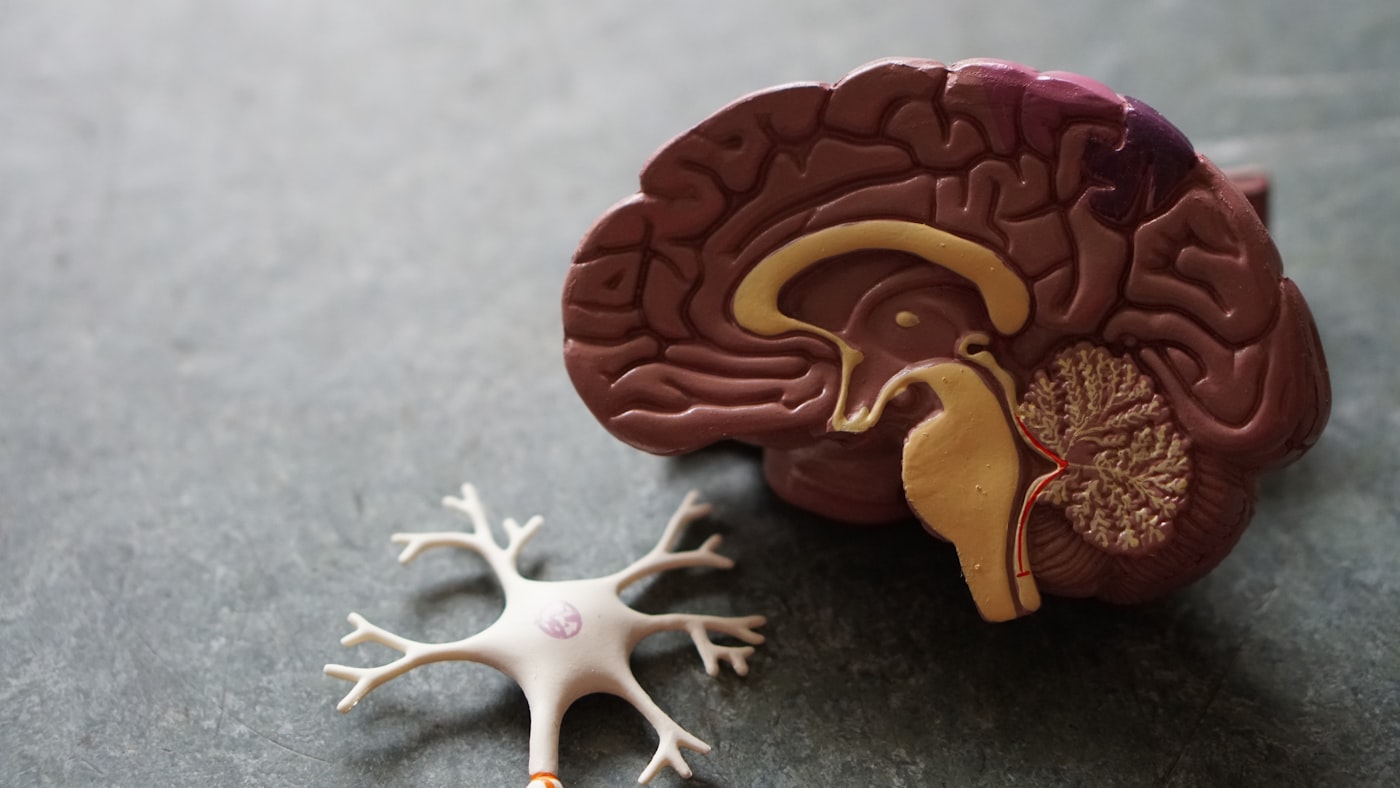
Researchers at Harvard and Google published in May 2024 what they described as the largest three-dimensional reconstruction of human brain tissue at synaptic resolution. The sample came from the temporal cortex—a cubic millimeter removed during epilepsy surgery—and the dataset alone consumed 1.4 petabytes of storage. Jeff Lichtman, professor of molecular and cellular biology at Harvard and the project's lead, called the amount of data "humbling."
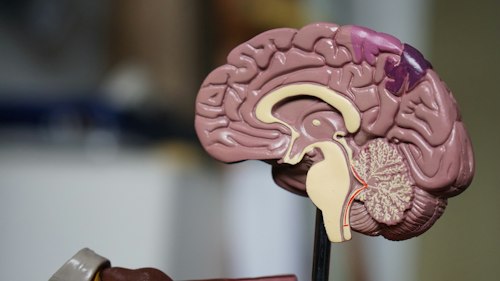
The temporal cortex sits beneath the lateral fissure on both hemispheres. It handles auditory processing, language comprehension, memory formation. Damage to different parts produces different deficits. A stroke in the posterior superior temporal gyrus—the region Carl Wernicke identified in 1874—leaves patients able to speak fluently but unable to understand what they hear or read. Their sentences come out grammatically intact but semantically empty, filled with invented words. Wernicke was 26 when he published his findings.

Wernicke's Discovery
Carl Wernicke identified the posterior superior temporal gyrus as critical for language comprehension. Damage to this region produces a distinctive aphasia: patients speak fluently but their words lack meaning.
Wernicke was 26 years oldThe Reconstruction Process
The Harvard-Google team sectioned the tissue into more than 5,000 slices, each about 30 nanometers thick. Image acquisition took 326 days. Machine learning algorithms stitched and aligned the slices, reconstructed each cell in three dimensions, traced axons and dendrites, labeled synapses. The final count: approximately 57,000 cells, 230 millimeters of blood vessels, 150 million synapses.
Reconstruction Methodology
The results contained structures that did not match existing textbook descriptions.
— Viren Jain, Neuroscientist at Google ResearchViren Jain, a neuroscientist at Google Research and co-author on the paper, said the results contained structures that did not match existing textbook descriptions. Axons typically form a single synapse with a target neuron. The team found rare cases where a single axon made up to 50 synaptic connections with the same cell. The function of these unusually strong bonds remains unknown.
Unexpected Discoveries
The team also observed "axon whorls"—structures in which an axon wraps into complicated knots, sometimes on the surface of another neuron. Nobody has explained what these do.
Multi-Synapse Axon Connections — up to 50 per cell
Axon Whorls — Knotted structures of unknown function
Glia outnumbered neurons two to one. Oligodendrocytes were the most common cell type. In the deepest cortical layer, triangular neurons showed a curious pattern: 77 percent had one basal dendrite larger than the others, and these large dendrites tilted toward one of two mirror-symmetrical angles. Neurons with one tilt clustered near others with the same orientation more than chance would predict.
In the deepest cortical layer, 77% of triangular neurons displayed asymmetric basal dendrites tilting toward mirror-symmetrical angles, with same-orientation neurons clustering together beyond random chance.
Multi-Synapse Axons
Rare cases found where a single axon made up to 50 synaptic connections with the same cell — far exceeding the typical single synapse.
Axon Whorls
Structures where axons wrap into complicated knots, sometimes on the surface of another neuron. Function remains unknown.
Glia Ratio
Glia outnumbered neurons two to one, with oligodendrocytes being the most common cell type.
Research Limitation
Because the tissue came from a patient with epilepsy, the researchers could not determine whether the unusual structures—the whorls, the multi-synapse axons—were pathological or simply rare in healthy brains. This limitation applies to most human connectomics work. Healthy brain tissue is difficult to obtain. Cadaver samples degrade quickly. Organoids grown in labs do not replicate the real architecture.
Historical Context
The temporal cortex has been mapped since the 19th century, but not at this resolution. Brodmann's 1909 classification divided it into areas 20, 21, 22, 37, 38, 41, and 42, based on cell arrangement visible under light microscopy. The Harvard-Google data operate at a different scale entirely—nanometers instead of millimeters.
Brodmann Areas of the Temporal Cortex
Classification from Korbinian Brodmann's 1909 cytoarchitectonic map, based on cell arrangement visible under light microscopy
Historical Timeline of Temporal Cortex Research
3D neural reconstruction visualization — the dataset is publicly available through the Neuroglancer platform
The dataset is publicly available through a platform called Neuroglancer. The preprint had been cited at least 136 times before formal publication.
formal publication


Lichtman's team plans next to reconstruct the mouse hippocampus. A complete mouse brain connectome would require roughly 1,000 times more data than the current human sample produced.
Looking Ahead: Mouse Hippocampus
Lichtman's team plans next to reconstruct the mouse hippocampus. A complete mouse brain connectome would require roughly 1,000 times more data than the current human sample produced.
complete mouse brain